_edited.png)

Bird Stories
Glossy Ibis (Plegadis falcinellus)
Des Palmer | March 2025
There are some words I can’t bring myself to say. “No” is one of them. If someone offers me a can of Coopers Pale Ale, that word definitely does not leave my lips. Racist comments about any group of people are also not on, except them flamin’… no, just kidding. The fact that people still don’t understand that there are good and bad people of all nationalities blows my mind. The other is that derogatory term used to describe ibis. You know the one, referring to a member of the poultry family residing at rubbish dumps. There, I didn’t have to say it.
We have three species of ibis in Australia: the straw-necked ibis, which are the black and white ones; the Australian white ibis, which are predominantly white; and the third type. The two more common species are unfairly labelled with the term I mentioned earlier. Sure, they are as common as clay. Sure, they sometimes scavenge and can be a nuisance in certain places. On the whole, however, they are simply birds trying to survive by any means they can. They are also known as the “farmer’s friend” because they consume large quantities of pasture pest insects. This provides an environmentally friendly alternative to sprays and pesticides. See, they are the good guys. Bet you will stop callin’ them bin chickens now. Doh, I just used the word I said I would not! Duh, brain.
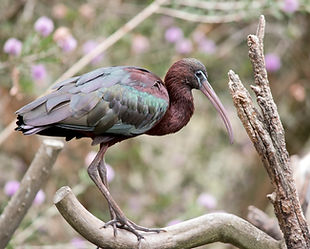
A third species, the glossy ibis, is a rare bird in southern Victoria. My tours of the Western Treatment Plant in Werribee give me the chance to see some special things, including four glossy ibis that are currently present. It is a real treat. These birds are very uncommon in this region, and I have only seen them here four times in my lifetime. So what are they doing here? Don’t ask me.
At a distance, they appear to be small and very dark ibis. Up close, especially in sunlight, their plumage shows as “a rich purplish brown, glossed with bronze and green, with a distinctive white line bordering the facial skin” (Pizzey and Knight). It is a truly stunning bird.
Glossy ibis feed in shallow wetlands, moving quickly as they search for prey such as small aquatic invertebrates.
They are far more common in northern Australia, where their breeding stronghold is the Macquarie Marshes in New South Wales. Their movements are described as “migratory, nomadic and irruptive.” In simple terms, this means they can appear at any suitable wetland at any time. Keep your eyes skinned, dear readers.
My tours to the WTP also mean I get to see plenty of other impressive wildlife. These include the glossy ibis mentioned earlier, dancing brolgas that remind me of my moves on the dance floor in the eighties, black falcons, spotted harriers, and plumed whistling ducks. The list goes on. It is a tough gig, alright.

Photos: Susan Flashman, Tatiana